What Is Unschooling? A Grounded Guide for Indian Parents
Unschooling is child-led learning without a fixed curriculum — not a gap year, not neglect. What it means in India, what families gain, and what they give up.
A parent in Pune recently described unschooling to her mother-in-law as "learning from life." Her mother-in-law heard: "watching TV all day." Both were partly right. Unschooling is neither a free-for-all nor a structured alternative to school — it is something more specific, harder to explain, and backed by enough documented experience to be worth understanding rather than dismissing.
This post covers the legal position, certification pathways, and what Indian families who have done this actually report. Also consider the differences between radical unschooling vs unschooling. It is not legal advice; verify your state's current rules before acting.
Where the word came from
The term "unschooling" was coined by John Holt — a Massachusetts schoolteacher who became convinced, after years in classrooms, that conventional schooling systematically suppressed the curiosity children were born with. His books How Children Learn (1967) and How Children Fail (1964) established his critique. In 1977 he launched the newsletter Growing Without Schooling, which introduced the word "unschooling" to parents who wanted to opt out entirely. Holt's work is cited in academic education literature across the world; this is documented intellectual history, not internet legend.
How unschooling differs from homeschooling
Homeschooling is a broad category — any education conducted primarily at home, including families who follow NIOS textbooks on a structured daily schedule. Unschooling is a specific philosophy within that category: the deliberate removal of an imposed curriculum, timetable, and external assessment, replaced by trust in the child's own curiosity to drive learning. A homeschooling family might replicate school at home. An unschooling family deliberately does not.
| Dimension | Structured homeschooling | Unschooling |
|---|---|---|
| Curriculum | Fixed (often NIOS or IGCSE syllabus) | None imposed — child-led |
| Schedule | Regular, often school-like timetable | Flexible or absent |
| Parent role | Primary teacher / instructor | Facilitator, resource-provider |
| Assessment | Regular tests, exam preparation | Portfolio-based until formal cert needed |
| Certification path | Planned from early on (e.g. NIOS) | Decided when child is ready (typically NIOS at 14) |
| Suits | Families who want academic rigour + flexibility | Families comfortable with ambiguity, child-driven pace |
What it actually looks like day to day
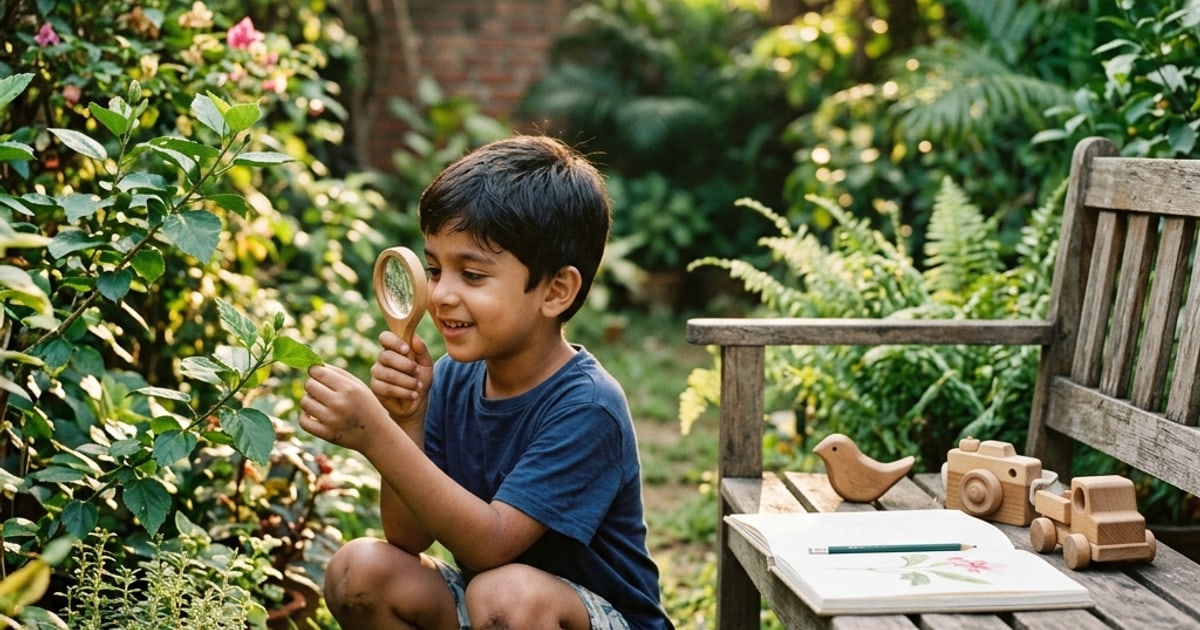
There is no single template. An 11-year-old in Hyderabad might spend months absorbed in the Indian Railways — timetables, locomotive history, the economics of fare revision, the geography of metre-gauge versus broad-gauge track. A 13-year-old in Bengaluru might apprentice with a local woodworker two days a week and spend the rest of the time on mathematics she chose herself. What distinguishes this from "doing nothing" is the parent's role: providing resources, responding to interests, facilitating experiences, asking questions — without imposing a syllabus or a timetable.
Is it legal in India?
The same legal framework applies as for all home learning. The RTE Act 2009 makes education "compulsory" for ages 6–14, but Section 2(b) defines this compulsion as the state's obligation to provide schooling — not a parental duty to send children to a school building. The Ministry of Human Resource Development confirmed in a 2011 counter-affidavit in the Delhi High Court that "parents who voluntarily opt for systems of home schooling and such alternate forms of schooling may continue to do so" and that the RTE Act does not make homeschooling or alternate schooling illegal. No unschooling family in India has been prosecuted under this Act.
What Indian families actually report
A 2018 paper published through the Alliance for Self-Directed Education documented the journeys of three middle-class Indian unschooling families. The families cited similar starting motivations: stress and anxiety in conventional schools, a sense that their children's natural curiosity was being flattened, and concerns about rigid competition. All three reported a "deschooling" transition period — weeks or months where children who had come from conventional school needed to decompress before they engaged with self-directed learning again. All three reported social pressure as the hardest part of unschooling, not the learning itself. "It is not the learning — it is the explaining," was a common theme.
Swashikshan (swashikshan.org), India's homeschooling and unschooling association, has active city chapters in Bengaluru, Mumbai, Pune, Delhi and Hyderabad. WithoutSchool.org maintains a directory of India-specific groups. These communities are where most Indian unschooling families find both support and social connection for their children.
The certification question — what unschoolers actually do
Unschooling does not come with a built-in certificate. When families decide they want one, the available routes are: NIOS (National Institute of Open Schooling) registration from age 14 for Class 10, then Class 12 — the most commonly used path; Cambridge IGCSE as a private candidate via an approved centre (British Council India is the main route); and state government open schools for regional-language or state-syllabus families. Most Indian unschooling families choose NIOS for its flexibility, low cost (approximately ₹1,890–2,200 admission fee for 5 subjects, ₹300 per subject exam fee — verify current rates at nios.ac.in), and twice-yearly exam windows. NIOS has been AIU-equivalent to other recognised boards since 1991.
Can unschoolers get into college — and sit NEET or JEE?
NIOS certificates are accepted by Indian universities directly, since NIOS is a national board. NIOS students are eligible for NEET UG — the National Medical Commission confirmed this under its GMER-2023 regulations (2024), provided students studied Physics, Chemistry, Biology and English with both theory and practical components. JEE and CUET accept NIOS on the same national-board footing, with Physics, Chemistry and Mathematics required for JEE. The honest note: not every private college admissions officer is equally familiar with NIOS. Some ask more questions. That is a real practical friction, not a disqualification.
The honest trade-offs
- What you gain: deep engagement with self-chosen subjects; freedom from exam anxiety and peer-rank comparison; scheduling that matches the child's energy rather than an institution's calendar; the ability to go genuinely deep on areas of passion.
- What you give up: the school's built-in social infrastructure — you have to build this deliberately through co-ops, community groups, activities, and Swashikshan networks. This is achievable but it requires intention.
- What demands more of you: a parent who is consistently present and actively engaged (not merely permissive); comfort with ambiguity about whether "enough" is happening; honest preparation for the NIOS exam, which tests a fixed syllabus regardless of how freely a child learned before.
- What is genuinely hard: the social pressure from relatives, neighbours, and former school friends. The families who report the most difficulty with unschooling name the external pressure, not the internal learning dynamics, as the primary challenge.
What the evidence says — honestly
Research on unschooling outcomes is sparse and mostly Western. The Indian-specific academic work is limited to case studies such as the 2018 Alliance for Self-Directed Education paper. What the available studies consistently show: strong intrinsic motivation and self-direction in learners; weaker predictable skill progression in areas children are not interested in. The honest takeaway is that outcomes depend heavily on the quality of parental facilitation and the individual child's temperament. Unschooling with an actively engaged parent who builds rich learning environments produces different results than unschooling with a distracted parent and no community.
Is unschooling right for your family?
Unschooling tends to work well when: at least one parent can be consistently present and responsive (not just available, but actively engaged with what the child is pursuing); the child shows genuine self-direction and interest-driven curiosity; and the family has or can build community support — other families, mentors, co-ops. It is more demanding of parents, not less — just differently demanding. Families who go in clear-eyed about the social infrastructure they need to build, and the NIOS preparation they need to start at 13–14, tend to do well. Families who expect unschooling to be low-effort find the middle years difficult.
Frequently asked questions
- At what age can we start?
- Any age. The RTE grey area covers 6–14, but no enforcement has occurred. NIOS registration opens at 14.
- Do we need to do anything official to "start"?
- No. No registration, notification or permission is needed at the national level. Withdraw from school (obtain a Transfer Certificate), join Swashikshan, and begin.
- When should we start NIOS preparation?
- Around age 13 is typical — gives a full year to cover the NIOS Class 10 syllabus before the first exam window at 14. The NIOS syllabus is available free at nios.ac.in.
- Is unschooling more work for parents than conventional schooling?
- Yes — different work. The demand is responsiveness and engagement rather than homework supervision and exam coaching. Most unschooling parents say years 1–2 are harder than years 3–5, once rhythm and community are established.
Ready to compare schools?
Browse online & alternate schools in India and the UAE on Skoolpin.
Find schools