Montessori vs Waldorf in India: Key Differences Explained
A clear breakdown of Montessori and Waldorf (Steiner) education in India: philosophy, structured materials vs imaginative play, teacher roles, and cost.

The core answer: Montessori centres on self-directed work with highly structured, self-correcting materials in mixed-age classrooms, focusing on early independence and reality-based tasks. Waldorf (Steiner) delays formal academics, emphasizing imagination, art, storytelling, and rhythm in the early years, with the same teacher staying with a class for several years.
When parents in India look beyond mainstream ICSE or CBSE schools for early childhood, the two most common progressive options are Montessori and Waldorf (often called Steiner). Both reject rote learning and testing in the early years, but their methods are radically different.
1. Philosophy and the child's work
Maria Montessori believed children absorb reality like a sponge. Her method is grounded in the real world: practical life skills (pouring, sweeping, buttoning) and specialized academic materials. A Montessori classroom feels like a miniature, orderly adult workplace. Fantasy and fairy tales are generally avoided in the early years; children are encouraged to understand the real world first.
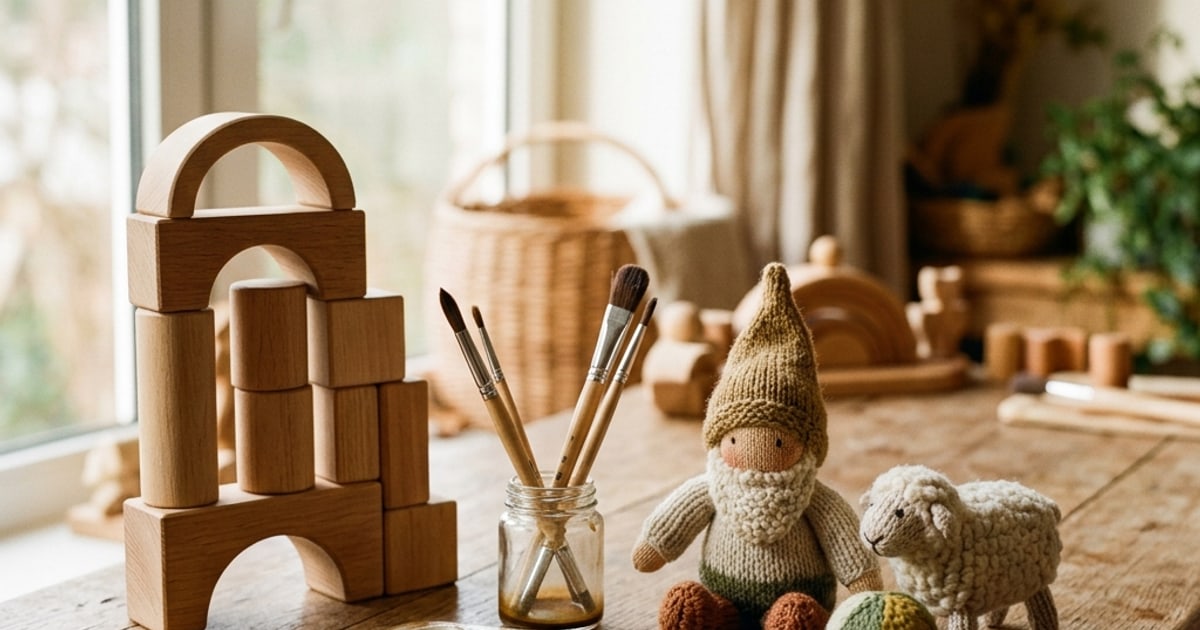
Rudolf Steiner (Waldorf) believed early childhood should be a time of dreamlike imagination. A Waldorf kindergarten feels like a home. There are no academic materials; children play with open-ended, natural objects (blocks of wood, silks). Learning happens through storytelling, singing, baking, and mimicking the teacher's purposeful work. Formal academics (reading, writing) are deliberately delayed until around age 7 (Class 1).
2. The classroom environment
Walk into a Montessori school in Bengaluru or Mumbai, and you'll see children working independently on mats or small tables. The teacher (called a "guide" or "directress") observes and gives individual lessons. Classrooms are mixed-age (e.g., 3-6 years old). The materials are self-correcting; a child knows if a puzzle piece doesn't fit without needing an adult to tell them.
Walk into a Waldorf school, and you'll see group activities led by the teacher: circle time, painting, or listening to a story. The walls are often painted in soft, specific colours (like peach or lazure blue). Toys are simple and undefined to encourage imagination. In a true Waldorf grade school, the class teacher often stays with the same group of students from Class 1 through Class 8 (called "looping").
| Feature | Montessori | Waldorf (Steiner) |
|---|---|---|
| Early Focus | Practical life, reality, structured materials | Imagination, play, art, storytelling |
| Academics | Introduced early, at child's pace | Delayed until Class 1 (around age 7) |
| Classroom | Mixed-age (3-6, 6-9, 9-12) | Same-age cohorts, often looping with one teacher |
| Toys/Materials | Specific, self-correcting academic materials | Open-ended, natural materials (wood, silk) |
| Role of Teacher | Observer, guide, gives individual lessons | Authority figure, storyteller, leads group |
3. Availability and cost in India
Montessori is vastly more common in India, though the term is not trademarked, meaning many preschools use the name without following the method. True AMI-recognised (Association Montessori Internationale) or Indian Montessori Centre (IMC) accredited schools exist, but they are fewer. A genuine Montessori primary programme might cost ₹1.2L to ₹2.5L annually in a metro city.
Waldorf schools are fewer and often extend through high school. Major hubs include Bengaluru, Pune, and Hyderabad, with established schools like Inodai (Mumbai) or Abhaya (Hyderabad). Because they require highly specialized teacher training and specific infrastructure, fees for a Waldorf grade school in a metro typically range from ₹1.5L to ₹3L annually. You can read more about evaluating them in our guide to alternative schools in India.
Making the choice
If you want your child to develop independence, a structured sense of order, and an early, self-paced grasp of math and language, Montessori is a strong fit. If you prefer to protect a longer, play-based childhood focused on art, rhythm, and imagination, with academics introduced much later, Waldorf is the clearer path.
- Which is better for learning to read early, Montessori or Waldorf?
- Montessori. It introduces phonetic sounds and reading mechanics early (often between ages 3-5) at the child's pace. Waldorf deliberately delays formal reading instruction until around age 7.
- Are Montessori and Waldorf schools recognised by Indian boards?
- Up to Class 8, many alternative schools operate independently. For Class 10 and 12, Waldorf and full-span Montessori schools typically affiliate with NIOS (National Institute of Open Schooling) or Cambridge (IGCSE) to provide a recognised certificate.
Ready to compare schools?
Browse online & alternate schools in India and the UAE on Skoolpin.
Find schools